

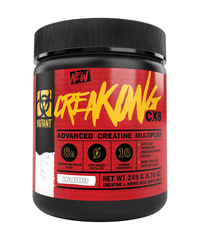
Mutant | Creakong CX8 | 30 Servings vs creatine monohydrate
// Ask SuppVault anything... █
Mutant | Creakong CX8 | 30 Servings Is For
Bodybuilders in high-volume hypertrophy phases who want more than plain creatine monohydrate. The 4g total creatine supports repeated high-output sets, while taurine and the amino blend add a hydration and recovery angle that fits pump-focused training well.
Lifters who train after work and want a stim-free performance product. Creakong CX8 delivers creatine-based strength support without caffeine, so it fits evening sessions where sleep quality still matters.
Intermediate gym-goers graduating from basic supplements who want a more feature-rich creatine. This formula gives them a clinically relevant total creatine dose plus taurine, BCAAs, glycine, arginine, and methionine in one scoop.
Athletes running repeated sprint, field sport, or explosive conditioning work who benefit from better phosphocreatine turnover. Creatine is strongest in short-duration, high-intensity performance, and the taurine support may help with hydration and fatigue resistance during dense sessions.
Lifters who dislike swallowing multiple capsules or managing separate tubs of creatine and aminos. Creakong CX8 condenses those categories into one daily powder, which makes adherence easier.
People who already respond well to creatine but want a slightly more 'loaded' formula. The triple-creatine approach and supportive amino system create a broader performance profile than straight monohydrate alone.
Athletes in mass-gaining phases who want better intracellular hydration and training output. Creatine’s osmotic effect draws water into muscle cells, and taurine reinforces that cell-volume support.
Users who want a daily training support supplement they can take on both training and rest days. Because the core benefit comes from creatine saturation, this product makes the most sense for consistent everyday use.
📱
Can't decide?
Text us your training style. We'll tell you which of these two is right for you.
Our Analysis
Creakong vs Creatine Monohydrate: Our No-BS Take
We've tested thousands of products in this store and used them ourselves for years. When someone asks us about Creakong versus creatine monohydrate, we tell them exactly what we've seen: you're comparing a hyped multi-creatine blend against the most studied, most proven, and usually cheapest form that actually delivers.
Short answer? Creatine monohydrate is still the king. Creakong tries to stand out with different creatine types plus taurine, but that blend game makes dosing murky and the evidence thinner. We've watched it play out with customers and in our own training.
Side-by-Side
| Feature | Creakong | Creatine Monohydrate |
|---|---|---|
| Product type | Multi-creatine blend | Single-ingredient creatine |
| Main ingredients | Creatine monohydrate, creatine magnesium chelate, tri-creatine malate, di-creatine malate, taurine | 100% creatine monohydrate |
| Typical serving | Often 3 capsules daily | Usually 3–5 g daily |
| Creatine dose transparency | Blend-based, often not clearly broken down by form | Fully transparent; exact grams listed |
| Clinically supported form | Partially includes monohydrate, but total dose per form may be unclear | Yes — this is the clinical benchmark |
| Delivery form | Capsules | Powder, capsules, gummies in some brands |
| Price positioning | Premium | Budget to mid-range |
| Best for | Capsule users who want a “fancier” formula | Anyone who wants proven results and best value |
Ingredients
Creakong comes at you with a "advanced creatine matrix": creatine monohydrate, creatine magnesium chelate, tri-creatine malate, di-creatine malate, and taurine. The marketing says all these forms together equal better uptake and less bloating.
We've tested enough of this stuff to call it: more forms doesn't equal better results. The vast majority of the research still backs plain creatine monohydrate for strength, size, and performance. The rest is mostly noise.
Straight creatine monohydrate is exactly that — 100% creatine monohydrate. No blends, no proprietary matrix, no extras. That's why we respect it. You know exactly what you're getting and the science is rock solid.
Dosing
Creakong usually comes in capsules with a recommended 3 capsules per day. Total creatine material lands around 3–4g per serving depending on the batch. Here's where we get annoyed: when it's a proprietary blend, they often don't break down how much is actual monohydrate versus the other forms. That means you can't tell if you're actually hitting a clinical dose.
Real creatine research uses 3–5g of creatine monohydrate daily. If a product can't show you that clearly, we get skeptical.
Monohydrate dosing is stupidly simple: 3–5g daily for maintenance. Optional loading phase of 20g split into 4 doses for 5–7 days then drop to 3–5g. Most of us here just run 5g every day and call it good. You get the exact dose the studies use. No guesswork.
Form
Creakong's real advantage is convenience. Capsules. No scooping, no mixing, easy to throw in a bag when traveling. We get why some guys hate powder.
But those capsules usually mean less creatine per serving, higher cost per actual gram, and more pills to hit 5g. Convenience becomes expensive real fast.
Monohydrate usually comes as powder (though capsules exist). It's the cheapest, easiest to dose precisely at 3–5g, and gives you the best value. Yeah, some people don't like the texture. We still say suck it up if performance and results matter.
Price
Creakong is premium priced because they slap "advanced matrix" on the label, throw in multiple forms, taurine, and capsules. You're paying for marketing and convenience.
Creatine monohydrate is one of the best values in the entire supplement industry. When you compare cost per effective 5g serving, monohydrate destroys these blends. We've run the numbers on thousands of products. The math doesn't lie.
Key Differences
Evidence: Not even close. Monohydrate has the strongest body of research for strength, power, training volume, and lean mass. Creakong includes some monohydrate but bets everything on the "multiple forms are better" story. We've seen that movie before. It usually ends with customers paying more for similar results.
Dose Transparency: Monohydrate tells you exactly how many grams. Creakong's blend often hides the details. We don't like playing guessing games with our customers' results.
Convenience: This is where Creakong actually wins for some people. If you refuse to use powder, capsules are legit.
Formula Extras: The added taurine might help with hydration. Nice bonus, but it doesn't fix weak dosing transparency.
Who Should Buy What
Buy Creakong if:
- You only do capsules and hate powder
- You want the multi-creatine formula and don't mind overpaying
- You've had stomach issues with certain monohydrate powders and want to try something different
- Convenience matters more to you than value
Buy Creatine Monohydrate if:
- You want the most proven form
- You care about clinical dosing
- You want the cheapest effective option
- You actually want the creatine that built most of the research data
For most lifters, athletes, and serious gym-goers, monohydrate is the correct choice.
Our Verdict
Creatine monohydrate wins.
We've tested both extensively. Creakong isn't bad, but it's a more expensive, less transparent version of something that doesn't need improving. The multi-form blend sounds fancy on paper but usually just means paying more for less clarity.
Monohydrate delivers the clinically supported form, exact 3–5g dosing, dramatically better value, and the strongest research for strength, power, and size.
Only time we'd tell you to grab Creakong is if capsules are a non-negotiable for you and you're happy to pay extra for that convenience. Otherwise, stop overcomplicating it. Just get plain creatine monohydrate. It's what we use and what we recommend to the majority of our customers.
We've tested thousands of products in this store and used them ourselves for years. When someone asks us about Creakong versus creatine monohydrate, we tell them exactly what we've seen: you're comparing a hyped multi-creatine blend against the most studied, most proven, and usually cheapest form that actually delivers.
Short answer? Creatine monohydrate is still the king. Creakong tries to stand out with different creatine types plus taurine, but that blend game makes dosing murky and the evidence thinner. We've watched it play out with customers and in our own training.
Side-by-Side
| Feature | Creakong | Creatine Monohydrate |
|---|---|---|
| Product type | Multi-creatine blend | Single-ingredient creatine |
| Main ingredients | Creatine monohydrate, creatine magnesium chelate, tri-creatine malate, di-creatine malate, taurine | 100% creatine monohydrate |
| Typical serving | Often 3 capsules daily | Usually 3–5 g daily |
| Creatine dose transparency | Blend-based, often not clearly broken down by form | Fully transparent; exact grams listed |
| Clinically supported form | Partially includes monohydrate, but total dose per form may be unclear | Yes — this is the clinical benchmark |
| Delivery form | Capsules | Powder, capsules, gummies in some brands |
| Price positioning | Premium | Budget to mid-range |
| Best for | Capsule users who want a “fancier” formula | Anyone who wants proven results and best value |
Ingredients
Creakong comes at you with a "advanced creatine matrix": creatine monohydrate, creatine magnesium chelate, tri-creatine malate, di-creatine malate, and taurine. The marketing says all these forms together equal better uptake and less bloating.
We've tested enough of this stuff to call it: more forms doesn't equal better results. The vast majority of the research still backs plain creatine monohydrate for strength, size, and performance. The rest is mostly noise.
Straight creatine monohydrate is exactly that — 100% creatine monohydrate. No blends, no proprietary matrix, no extras. That's why we respect it. You know exactly what you're getting and the science is rock solid.
Dosing
Creakong usually comes in capsules with a recommended 3 capsules per day. Total creatine material lands around 3–4g per serving depending on the batch. Here's where we get annoyed: when it's a proprietary blend, they often don't break down how much is actual monohydrate versus the other forms. That means you can't tell if you're actually hitting a clinical dose.
Real creatine research uses 3–5g of creatine monohydrate daily. If a product can't show you that clearly, we get skeptical.
Monohydrate dosing is stupidly simple: 3–5g daily for maintenance. Optional loading phase of 20g split into 4 doses for 5–7 days then drop to 3–5g. Most of us here just run 5g every day and call it good. You get the exact dose the studies use. No guesswork.
Form
Creakong's real advantage is convenience. Capsules. No scooping, no mixing, easy to throw in a bag when traveling. We get why some guys hate powder.
But those capsules usually mean less creatine per serving, higher cost per actual gram, and more pills to hit 5g. Convenience becomes expensive real fast.
Monohydrate usually comes as powder (though capsules exist). It's the cheapest, easiest to dose precisely at 3–5g, and gives you the best value. Yeah, some people don't like the texture. We still say suck it up if performance and results matter.
Price
Creakong is premium priced because they slap "advanced matrix" on the label, throw in multiple forms, taurine, and capsules. You're paying for marketing and convenience.
Creatine monohydrate is one of the best values in the entire supplement industry. When you compare cost per effective 5g serving, monohydrate destroys these blends. We've run the numbers on thousands of products. The math doesn't lie.
Key Differences
Evidence: Not even close. Monohydrate has the strongest body of research for strength, power, training volume, and lean mass. Creakong includes some monohydrate but bets everything on the "multiple forms are better" story. We've seen that movie before. It usually ends with customers paying more for similar results.
Dose Transparency: Monohydrate tells you exactly how many grams. Creakong's blend often hides the details. We don't like playing guessing games with our customers' results.
Convenience: This is where Creakong actually wins for some people. If you refuse to use powder, capsules are legit.
Formula Extras: The added taurine might help with hydration. Nice bonus, but it doesn't fix weak dosing transparency.
Who Should Buy What
Buy Creakong if:
- You only do capsules and hate powder
- You want the multi-creatine formula and don't mind overpaying
- You've had stomach issues with certain monohydrate powders and want to try something different
- Convenience matters more to you than value
Buy Creatine Monohydrate if:
- You want the most proven form
- You care about clinical dosing
- You want the cheapest effective option
- You actually want the creatine that built most of the research data
For most lifters, athletes, and serious gym-goers, monohydrate is the correct choice.
Our Verdict
Creatine monohydrate wins.
We've tested both extensively. Creakong isn't bad, but it's a more expensive, less transparent version of something that doesn't need improving. The multi-form blend sounds fancy on paper but usually just means paying more for less clarity.
Monohydrate delivers the clinically supported form, exact 3–5g dosing, dramatically better value, and the strongest research for strength, power, and size.
Only time we'd tell you to grab Creakong is if capsules are a non-negotiable for you and you're happy to pay extra for that convenience. Otherwise, stop overcomplicating it. Just get plain creatine monohydrate. It's what we use and what we recommend to the majority of our customers.
