

This product
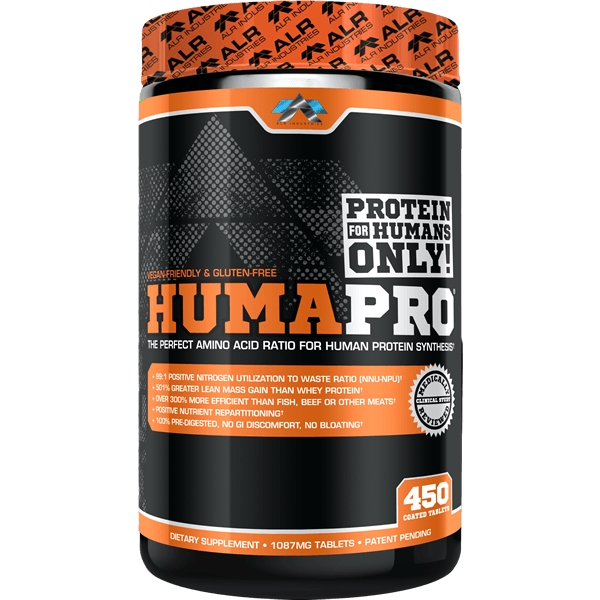
 ALR Industries | HumaPro Tabs | 60 ServingsALR Industries
- SuppVault Score
- 97/100
Key actives
ALR Industries
Portable 5g EAA support in a no-mix tablet format
$37.95 $47.95 SuppVault Summary
Portable amino support in five tablets. HumaPro delivers a 5g leucine-containing EAA matrix plus B-vitamins, minerals, and nutrient-partitioning support for missed meal windows and low-calorie recovery use.
ALR Industries publishes test results from independent third-party labs. Svpplements links to the manufacturer’s data — we don’t test products ourselves.
Discount applied automatically in cart.


Creatine and EAAs solve different problems. HumaPro helps cover amino availability around training and missed meals, while creatine saturates muscle phosphocreatine stores to support strength, power output, and ATP regeneration.
Take creatine daily anytime; use HumaPro around training or between meals

HumaPro is best used as a bridge, not a replacement for full protein feedings. A whey isolate gives you a complete, high-protein meal support option when you need total protein grams, while HumaPro covers the windows when convenience wins.
Use HumaPro pre-workout or between meals; use whey after training or to complete daily protein intake

If you like the idea of amino support but want a powdered companion product for home or training sessions, a dedicated EAA powder creates a stronger at-home option while HumaPro handles travel and convenience. This is a smart two-format strategy for people who alternate between gym access and on-the-go days.
Use HumaPro on the go; use powdered EAAs during or around training at home

Glutamine does not replace EAAs, but it can complement a recovery stack focused on training volume, gut stress, and dieting phases. HumaPro covers essential amino triggers and building blocks, while glutamine adds a separate recovery and gut-support angle.
Take HumaPro around training; take glutamine post-workout or between meals
Same HumaPro concept; choice likely comes down to format or serving count preference.
A dedicated EAA powder is typically easier to dose transparently and often stronger for at-home workout use.
For total protein intake and post-workout recovery, a whey isolate is categorically stronger than amino tablets.
HumaPro wins only if the shopper specifically needs portable amino support instead of creatine's strength-focused benefits.
Side-by-side against the closest competitors. Score reflects clinical dosing, transparency, and testing.
ALR Industries | HumaPro Tabs | 60 ServingsALR Industries
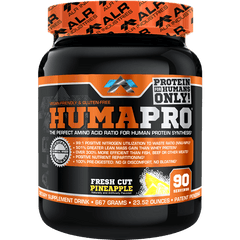 ALR Industries | Humapro AminosALR Industries
Same HumaPro concept; choice likely comes down to format or serving count preference.
Compare side-by-side → Hi-Tech Pharmaceuticals | Precision EAAs | 30 ServingsHi-Tech Pharmaceuticals
A dedicated EAA powder is typically easier to dose transparently and often stronger for at-home workout use.
Compare side-by-side → Nutrastop | ABE Whey ISO | 27 ServingsNutrastop
For total protein intake and post-workout recovery, a whey isolate is categorically stronger than amino tablets.
Compare side-by-side →Comparison data combines live storefront pricing with our SuppVault analysis. Competitor scores reflect public-label data; manufacturer-side changes may not be reflected in real time.
ALR Industries I HumaPro Tabs is a tablet-based essential amino acid formula built around one central idea: give the body the amino acids it cannot make on its own, emphasize the branched-chain trigger amino acids that initiate muscle protein synthesis, and do it in a highly portable, low-calorie format. That concept is legitimate. Essential amino acids, not just total grams of random amino acids, are what the body requires to build new muscle protein. Where HumaPro becomes more nuanced is that it delivers its core aminos through a 5g proprietary matrix, so the formula philosophy is sound, but the label transparency is not ideal.
The backbone of the formula is leucine, valine, and isoleucine, supported by lysine, threonine, phenylalanine, methionine, tryptophan, tyrosine, histidine, cystine, and leucine malate. Leucine is the star from a performance standpoint because it directly activates the mTOR pathway, the molecular signal that turns on muscle protein synthesis. In published literature, leucine is typically effective in the 2.5-5g range. Here, leucine is present, but because the entire amino matrix is only 5g total and split across 11+ amino ingredients, the leucine dose is undisclosed and almost certainly below the stand-alone clinical range. That does not make the formula useless. It means this product functions best as a broad EAA support formula rather than a fully disclosed leucine-dominant anabolic trigger dose.
Valine and isoleucine round out the BCAA trio. Valine competes with tryptophan at the blood-brain barrier, which is one reason BCAA-heavy formulas are often used to reduce perceptions of central fatigue during training. Isoleucine contributes to glucose uptake into skeletal muscle and supports muscle energy metabolism. Together with leucine, they help create a more training-friendly amino environment than leucine alone. The remaining EAAs matter because BCAAs cannot build complete muscle tissue by themselves. Lysine supports protein structure and collagen-related processes, threonine supports structural proteins and gut mucin production, methionine supports methylation and sulfur amino acid metabolism, and tryptophan plus phenylalanine/tyrosine contribute to neurotransmitter precursor status.
The supporting micronutrients are modest but purposeful. Vitamin B1, B3, B6, and B12 are included in small amounts that align with general energy metabolism and amino acid handling rather than high-dose performance support. Magnesium citrate, calcium carbonate, and zinc gluconate add light mineral coverage relevant to muscle contraction, enzyme activity, and electrolyte balance, though none are dosed high enough to redefine the category.
The 210mg support matrix with bitter melon extract and caffeine-free green coffee bean extract appears designed for nutrient partitioning and insulin-mimetic support. Bitter melon has a long history in glucose management research and is often used in glucose disposal formulas to support cellular nutrient uptake. In this context, the logic is clear: pair essential amino acids with ingredients intended to improve how nutrients are handled. The problem is the same as the amino matrix: no individual doses are disclosed, so precision assessment is limited.
As a system, HumaPro works as a portable EAA tablet designed to support recovery, reduce the gap between meals, and give athletes a low-calorie amino option when whole-food protein is inconvenient. On day 1, expect convenience, easy dosing, and a light amino support effect rather than a dramatic perceptible hit. Over 2-4 weeks of consistent use around training and between meals, it can help reinforce total daily essential amino acid intake, especially during dieting phases. The honest verdict: the concept is strong, the ingredient selection is intelligent, but the proprietary blend structure prevents this from being a fully verifiable top-tier amino formula.
Leucine is the most anabolic signaling amino acid in sports nutrition because it directly activates the mTOR complex, a central regulator of muscle protein synthesis. This is why leucine content matters disproportionately in EAA formulas. However, leucine is only the trigger; the rest of the essential amino acid pool must also be available to sustain actual tissue construction. In proprietary EAA blends, the key question is always whether leucine is present in a truly meaningful proportion of the total blend.
BCAAs can influence fatigue and contribute to the muscle protein synthesis trigger, but they do not provide all required substrates for building new muscle tissue. Essential amino acids such as lysine, threonine, methionine, and tryptophan are required because the body cannot synthesize them. That is why EAA-based formulas are physiologically stronger than BCAA-only products when the goal is recovery and muscle protein synthesis support. HumaPro's formula architecture reflects that logic, even if the exact internal amino distribution is hidden.
Valine and isoleucine are often overshadowed by leucine, but both have relevant exercise physiology roles. Valine competes with tryptophan transport across the blood-brain barrier, a mechanism linked to perceived central fatigue during training. Isoleucine contributes to skeletal muscle glucose uptake and energy handling. Together with leucine, they create a more complete branched-chain support cluster than leucine alone.
Bitter melon extract is frequently used in glucose-disposal and nutrient-partitioning supplements because of its insulin-mimetic and blood glucose support mechanisms. In an amino formula, that pairing suggests an attempt to improve how incoming nutrients are handled rather than simply increasing amino delivery. This is a rational formulation concept, especially for cutting and recomposition contexts. The limitation is dose opacity, which prevents a stronger evidence-based verdict in this specific product.
Verified athletes can view NCAA, WADA, and high-school compliance status for this product.
* These statements have not been evaluated by the Food and Drug Administration. This product is not intended to diagnose, treat, cure, or prevent any disease. Consult your physician before use if you have a medical condition or take medications.
Drop your number and our team will instantly text you.
Our team is on it. Check your texts — real advice, real fast.
Brain-curated complementary picks for synergy and full-spectrum coverage.
55
69
Secure sign in
Svpplements uses Shopify Customer Accounts for protected login, order history, and account data.