

This product
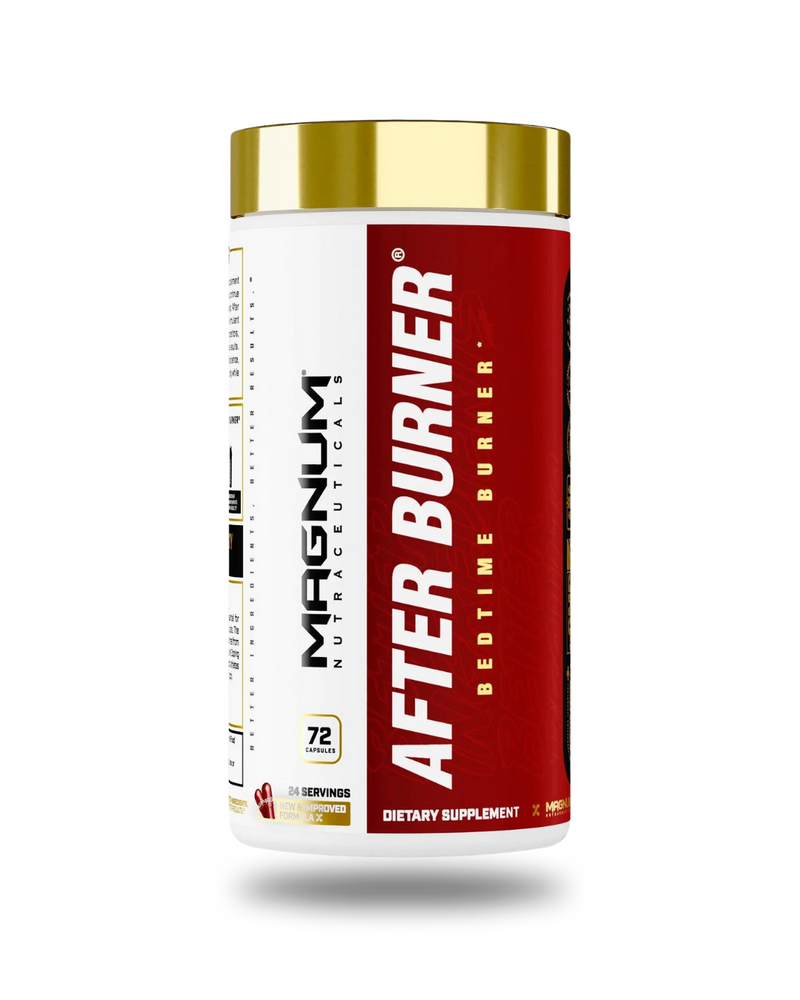
 Magnum Nutraceuticals | After Burner | 72 CapsulesMagnum Nutraceuticals
- SuppVault Score
- 68/100
- Per serving
- $1.33
Key actives
Tested
Magnum Nutraceuticals
Stim-free amino support for cutting without sacrificing lean mass
$31.99 $1.33/serving SuppVault Summary
After Burner is a body-composition support formula built more for muscle retention than stimulant-heavy thermogenesis. Its standout design combines undisclosed BCAAs with 1,000mg KIC and 1,000mg glycine-L-arginine to support anti-catabolic dieting and training-day nutrient delivery.
Magnum Nutraceuticals publishes test results from independent third-party labs. Svpplements links to the manufacturer’s data — we don’t test products ourselves.
Discount applied automatically in cart.


Creatine complements After Burner perfectly in a cutting phase because it supports phosphocreatine regeneration and helps preserve performance output even when calories are lower. That pairs well with the formula’s leucine/KIC strategy, which is more about muscle retention and recovery signaling than ATP regeneration.
Take daily; with After Burner pre-workout or any time of day on rest days
This is one of the smartest pairings because leucine and BCAAs work best when total protein intake is already sufficient. A complete protein provides all essential amino acids, while After Burner adds extra leucine-centered signaling and anti-catabolic support around the margins.
Use post-workout or any time needed to hit daily protein targets
During a cut, especially if cardio volume is higher, hydration quality often drops and training can feel flatter. An electrolyte formula complements After Burner’s blood-flow and training-support angle by helping maintain fluid balance, muscular contraction, and session quality.
Pre-, intra-, or post-workout depending on sweat loss
Because glycine-L-arginine here is supportive but below stronger arginine research ranges, a dedicated nitric-oxide product with clinical-dose citrulline can significantly enhance the vascular side of the stack. That gives you more acute blood-flow performance while After Burner handles the lean-mass preservation angle.
20-30 minutes pre-workout alongside After Burner
Drip Dry is likely more directly aligned with conventional cutting expectations and visible fat-loss support.
Fasted Cardio should suit users specifically wanting a more dedicated fasted-fat-loss experience.
Carne Diem is more metabolism-focused, while After Burner leans harder into lean-mass retention.
After Burner stands out if your priority is preserving training quality and muscle while dieting.
Side-by-side against the closest competitors. Score reflects clinical dosing, transparency, and testing.
Magnum Nutraceuticals | After Burner | 72 CapsulesMagnum Nutraceuticals
 Magnum Nutraceuticals | Drip Dry | 90 CapsulesMagnum Nutraceuticals
Drip Dry is likely more directly aligned with conventional cutting expectations and visible fat-loss support.
Compare side-by-side → Magnum Nutraceuticals | Fasted Cardio | 40 ServingsMagnum Nutraceuticals
Fasted Cardio should suit users specifically wanting a more dedicated fasted-fat-loss experience.
Compare side-by-side → Magnum Nutraceuticals | Carne Diem | 96 CapsulesMagnum Nutraceuticals
Carne Diem is more metabolism-focused, while After Burner leans harder into lean-mass retention.
Compare side-by-side →Comparison data combines live storefront pricing with our SuppVault analysis. Competitor scores reflect public-label data; manufacturer-side changes may not be reflected in real time.
Magnum Nutraceuticals After Burner is not a conventional stim-heavy fat burner. Based on the verified label provided here, it is better understood as a stim-free body-composition support formula built around amino acid metabolism, anti-catabolic support, and nutrient-delivery logic rather than caffeine-driven appetite suppression. The formulation strategy is unusual for the category: instead of leading with thermogenic stimulants, it leans on branched-chain amino acids in both free-form and ethyl ester forms, 1,000mg leucine alpha-ketoisocaproate calcium, and 1,000mg glycine-L-arginine, with a small B-vitamin support layer.
The central ingredient story starts with leucine. Free-form L-leucine is the most important anabolic signaling amino acid in sports nutrition because it directly activates mTOR, the pathway that initiates muscle protein synthesis. Clinical literature commonly places leucine in the 2.5-5g range when the goal is meaningful signaling. This formula does include leucine, but its dose is not disclosed, so no honest reviewer can call it clinically dosed. The same transparency limitation applies to L-isoleucine and L-valine, plus their ethyl ester HCl counterparts. Mechanistically, the free-form BCAAs support muscle repair and recovery, while isoleucine also contributes to skeletal-muscle glucose uptake and valine is associated with central-fatigue modulation through competition with tryptophan at the blood-brain barrier. The ethyl ester forms are included for a theoretical absorption and membrane-permeability advantage, but human outcome data on these esterified versions are still emerging. That makes them interesting, but not stronger evidence than the free-form amino acids themselves.
The most concrete, fully assessable active here is L-leucine alpha-ketoisocaproate calcium at 1,000mg. KIC is a leucine metabolite often used for anti-catabolic and recovery-oriented positioning. While it is not as universally established as leucine itself for directly driving protein synthesis, it fits the formula’s stated logic: reduce muscle breakdown pressure during dieting and support training resilience when calories are lower. Glycine-L-arginine at 1,000mg contributes arginine, the direct precursor to nitric oxide. Nitric oxide promotes vasodilation, which supports blood flow and nutrient delivery. The limitation is dose: oral arginine research often uses 2-4g taken multiple times daily, and citrulline generally outperforms arginine for sports performance because of better bioavailability. So 1,000mg is directionally useful but below the stronger research range.
The B-vitamin layer is modest: niacin at 3mg, vitamin B6 at 0.3mg, vitamin B12 at 0.7mcg, and folic acid at 50mcg. These support normal energy metabolism, amino acid handling, and red blood cell-related physiology, but they are not dosed aggressively enough to define the experience.
Synergy-wise, the formula is built around preserving lean tissue while supporting training output in a calorie deficit. Leucine provides the mTOR trigger, isoleucine and valine round out the BCAA metabolic role, KIC adds a leucine-metabolite recovery angle, and glycine-L-arginine supports circulation. The label is partially transparent: there is no proprietary blend, which is a real positive, but several amino acids still have undisclosed individual amounts. That is better than a blend, but still prevents full clinical dose verification.
What should you expect? Day 1 is subtle. This is not a stimulant product, so you should not expect a rush. Over 2-4 weeks, the intended benefit is better muscle retention support, steadier recovery during a cut, and a more “held together” feeling in training when calories are reduced. The concept is smart and niche; the main limitation is incomplete dose disclosure on the very ingredients that most determine whether the formula reaches clinical territory.
Leucine is the dominant branched-chain amino acid trigger for mTORC1 activation, the central pathway governing muscle protein synthesis initiation. During a calorie deficit, that signaling role becomes more important because total anabolic drive is often reduced while proteolysis pressure rises. A leucine-centered formula can therefore support lean-mass retention logic even when overall calories are lower. The limitation here is that the full leucine payload is not disclosed, so mechanistic intent is stronger than dose certainty.
Alpha-ketoisocaproate is a principal metabolite of leucine and has been studied for its role in nitrogen handling and attenuation of muscle protein breakdown. In practical sports nutrition, KIC is often positioned as an anti-catabolic adjunct rather than a primary hypertrophy driver. That distinction matters in a cutting formula, where preserving tissue is often more relevant than maximizing growth. At 1,000mg disclosed, it provides a meaningful signal of the product’s preservation-focused architecture.
Glycine-L-arginine supplies arginine, the direct substrate for nitric oxide synthase, which can support endothelial nitric oxide production and vasodilation. Better blood flow may improve subjective pump, nutrient delivery, and exercise feel, particularly when taken pre-workout. Oral arginine is limited by first-pass metabolism, so lower doses tend to produce subtler outcomes than more robust clinical protocols. Even so, 1,000mg can still contribute to the smoother, circulation-oriented profile described for this formula.
Isoleucine and valine complement leucine by contributing to whole-body amino acid availability, recovery support, and exercise metabolism during dieting phases. While BCAAs are not equivalent to a full essential amino acid formula, they can still be strategically useful when protein intake timing is imperfect or training stress is high. The inclusion of both free-form and ethyl ester versions suggests an absorption-positioning strategy rather than a simple commodity BCAA blend. Because doses are hidden, efficacy confidence is moderate rather than definitive.
Verified athletes can view NCAA, WADA, and high-school compliance status for this product.
* These statements have not been evaluated by the Food and Drug Administration. This product is not intended to diagnose, treat, cure, or prevent any disease. Consult your physician before use if you have a medical condition or take medications.
Drop your number and our team will instantly text you.
Our team is on it. Check your texts — real advice, real fast.
 97
97
 65
65
 73
70
73
70
 67
81
67
81
 80
80
 87
87
Secure sign in
Svpplements uses Shopify Customer Accounts for protected login, order history, and account data.