This product
 Bucked Up | Mixed GreensBucked Up
- SuppVault Score
- 93/100
Bucked Up
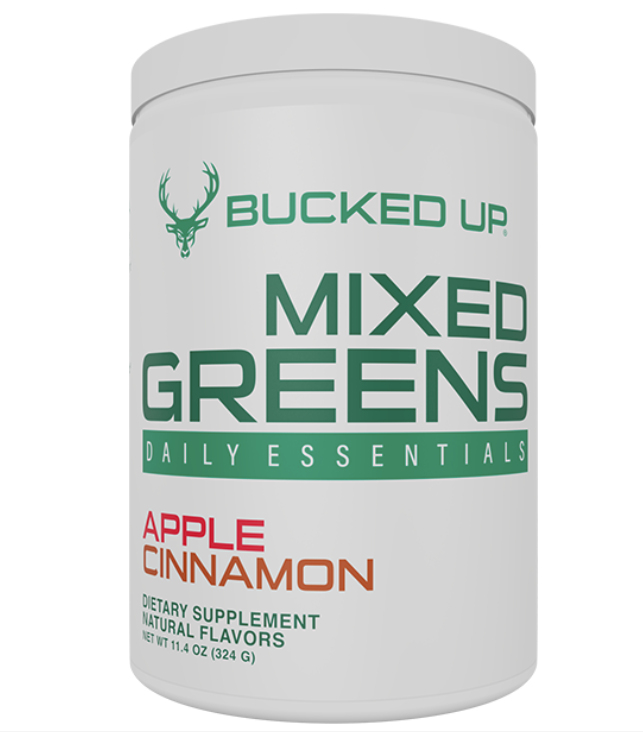
Transparent daily greens with a full-dose 2,250mg kale core
$39.95
Get Notified When Back in Stock
We'll email you once when this product is restocked. No spam.
SuppVault Summary
Bucked Up Mixed Greens is a transparent daily greens powder built around eight recognizable plant ingredients, not filler-heavy blends. It focuses on micronutrient density, antioxidant support, and greens consistency, led by 2,275mg barley grass, 2,250mg wheat grass, and 2,250mg kale.
Bucked Up publishes test results from independent third-party labs. Svpplements links to the manufacturer’s data — we don’t test products ourselves.
Discount applied automatically in cart.


Mixed Greens covers plant-based micronutrient density, but it does not address phosphocreatine replenishment or high-intensity strength output. Adding standalone creatine complements this formula perfectly by covering ATP regeneration while greens support the nutritional side of your routine.
Take daily at any time; it can be used alongside Mixed Greens or with a separate meal.
Protein and greens solve different problems. Protein supports muscle protein synthesis and recovery, while this formula helps maintain more consistent intake of greens-derived micronutrients and phytonutrients during busy or repetitive meal phases.
Use protein around training or to fill protein gaps; use Mixed Greens whenever daily consistency is easiest.
Kale provides carotenoids and fat-soluble phytonutrients, and omega-3 supplementation pairs well with a greens formula in a broader wellness stack. The two products complement each other by covering different nutritional domains: plant antioxidants from greens and essential fatty acids from fish oil.
Take both with a meal, ideally one containing dietary fat.
A multivitamin covers defined vitamin and mineral intake targets, while Mixed Greens adds phytonutrients, chlorophyll-rich grasses, and whole-food plant diversity that standard multis often lack. Together they create a more complete nutritional foundation than either one alone.
Take with breakfast or lunch; they can be used in the same daily routine.
This formula is not designed to energize or boost training intensity acutely. If your goal is better workouts plus better daily nutrition habits, pair Mixed Greens with a separate pre-workout or coffee so each product handles a distinct job instead of expecting one formula to do everything poorly.
Use Mixed Greens anytime daily; use your energy product 20-30 minutes pre-workout.
Both serve the same daily greens role, so preference likely comes down to flavor and formula style.
Mixed Greens offers actual plant-based greens coverage rather than relying only on isolated vitamins and minerals.
Revive typically has broader category reputation and a more feature-rich greens positioning.
Bucked Up Mixed Greens stands out for its straightforward disclosed formula built around large primary greens doses.
Side-by-side against the closest competitors. Score reflects clinical dosing, transparency, and testing.
Bucked Up | Mixed GreensBucked Up
 Bucked Up | Greens | 30 ServingsBucked Up
Both serve the same daily greens role, so preference likely comes down to flavor and formula style.
Compare side-by-side → Bucked Up | Multivitamin | 60 CapsulesBucked Up
Mixed Greens offers actual plant-based greens coverage rather than relying only on isolated vitamins and minerals.
Compare side-by-side → Revive | Daily Greens | 20 ServingsRevive
Revive typically has broader category reputation and a more feature-rich greens positioning.
Compare side-by-side →Comparison data combines live storefront pricing with our SuppVault analysis. Competitor scores reflect public-label data; manufacturer-side changes may not be reflected in real time.
Bucked Up Mixed Greens is a straightforward greens formula built around eight recognizable plant ingredients rather than a bloated “superfood” panel full of token inclusions. The formulation philosophy is clear: anchor the product with heavy doses of cereal grasses and kale, then support that base with smaller but purposeful amounts of cruciferous vegetables, leafy greens, and microalgae. That gives the user a broad-spectrum greens profile focused on micronutrient density, antioxidant support, chlorophyll-rich plant matter, and general wellness support rather than acute ergogenic effects.
The top of the formula is where most of the value sits. Barley Grass at 2,275mg and Wheat Grass at 2,250mg provide the core “greens powder” identity: chlorophyll-rich grasses that contribute vitamins, minerals, and phytonutrients associated with daily wellness and nutritional coverage. Bucked Up also includes Kale at 2,250mg, which matters because this lands directly in the 1,800-2,250mg clinical range referenced in the knowledge base. Kale is one of the strongest ingredients here from an evidence perspective. It delivers lutein and zeaxanthin for ocular antioxidant defense, vitamin K for bone-related carboxylation processes, and a useful matrix of potassium, magnesium, and plant compounds that support vascular and metabolic health. In practical terms, this is one of the few ingredients in the formula dosed at a level that aligns well with research-backed use.
Alfalfa at 625mg also lands at the top of its referenced range. Its role is less about a dramatic acute effect and more about adding micronutrients, chlorophyll, vitamin K, and antioxidant plant compounds. Broccoli at 500mg is appropriately positioned for a whole-food powder dose. Broccoli’s significance comes from glucoraphanin, which can convert into sulforaphane and activate the Nrf2 pathway tied to endogenous antioxidant defenses and Phase II detoxification enzymes. One important limitation: the label does not disclose a myrosinase source or sulforaphane standardization, so this is best viewed as general broccoli whole-food support rather than a specialized sulforaphane product.
Spinach at 500mg sits at the low end of the cited useful range. Depending on processing, spinach can contribute nitrates, carotenoids, and other phytonutrients, but this is not presented as a standardized nitrate or thylakoid ingredient, so expectations should stay realistic. Spirulina at 300mg and Chlorella at 300mg are the most obviously underdosed ingredients relative to the human research ranges typically used for standalone benefits, which are measured in multiple grams per day. They still contribute to formula diversity and add some phytonutrients and pigments, but they are not present at the doses usually used in trials showing stronger lipid, blood pressure, or antioxidant outcomes.
As a system, the formula combines grasses, cruciferous vegetables, leafy greens, and algae to create broad-spectrum phytonutrient coverage. Kale, broccoli, and spinach cover the leafy/cruciferous side, while spirulina and chlorella expand the antioxidant and micronutrient profile. The transparency is a major positive: no proprietary blend, no hidden milligrams, and no disguised fairy-dusting. That honesty matters in a category full of label clutter.
What should you expect? Day 1 is not a “rush” product. Expect a convenient way to increase greens intake and likely a light, easy-on-the-stomach addition to your routine. Over 2-4 weeks, the value is cumulative: more consistent intake of greens-derived micronutrients, chlorophyll-rich plant matter, and cruciferous compounds than many people get from their actual diets. The biggest strength here is simplicity and transparency. The biggest limitation is that spirulina and chlorella are included more for breadth than for fully clinical standalone dosing.
Kale, spinach, and related leafy greens contribute carotenoids, folate, and vitamin K-associated compounds that support baseline nutritional sufficiency. Their primary value in powder formulas is not acute ergogenesis but repeated exposure to dense plant micronutrients when vegetable intake is inconsistent. That mechanism is best understood as nutritional insurance rather than a drug-like effect.
Barley grass and wheat grass function mainly as concentrated whole-food greens inputs supplying chlorophyll-rich plant matter and broad phytonutrient exposure. In mixed formulas, they create volume and consistency in total greens intake rather than targeting a single isolated pathway. This makes them more relevant for routine dietary coverage than for measurable acute performance outcomes.
Broccoli-containing formulas are often discussed in the context of glucosinolate metabolites and downstream redox signaling effects. In clinical literature, outcomes are usually tied to standardized sulforaphane equivalents rather than raw whole-food weight, so direct translation from label milligrams is imperfect. Even so, broccoli contributes useful cruciferous diversity to a wellness-focused greens profile.
Spirulina and chlorella are frequently studied for antioxidant activity, nutrient density, and adjunctive wellness support, but meaningful trial doses are commonly higher than the amounts seen in blended greens formulas. At lower inclusion levels, their role is best viewed as supportive diversification of the plant matrix. They add breadth, though not necessarily standalone clinical impact at these doses.
Verified athletes can view NCAA, WADA, and high-school compliance status for this product.
* These statements have not been evaluated by the Food and Drug Administration. This product is not intended to diagnose, treat, cure, or prevent any disease. Consult your physician before use if you have a medical condition or take medications.
Drop your number and our team will instantly text you.
Our team is on it. Check your texts — real advice, real fast.
Secure sign in
Svpplements uses Shopify Customer Accounts for protected login, order history, and account data.