This product
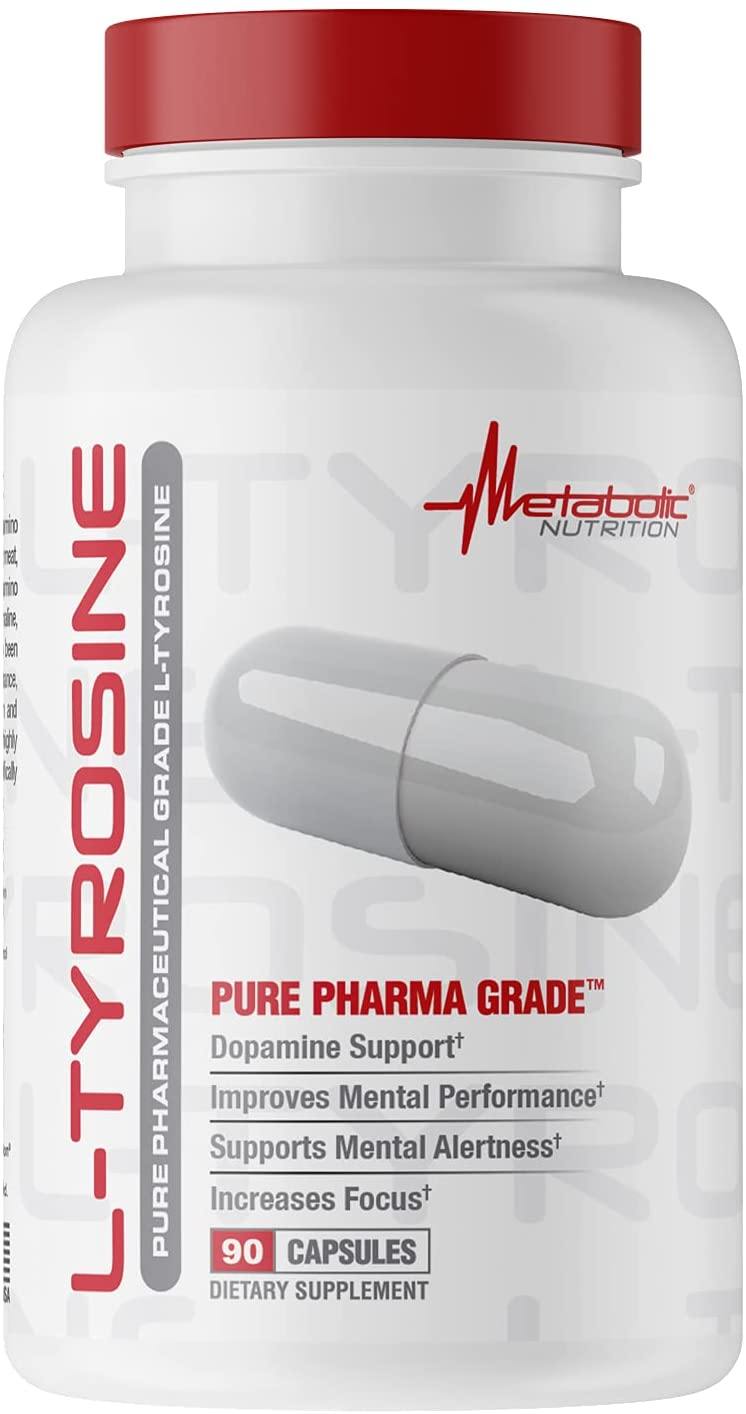
 Metabolic Nutrition | L-Tyrosine Caps | 90 CapsulesMetabolic Nutrition
- SuppVault Score
- 88/100
- Per serving
- $0.12
Key actives
Metabolic Nutrition
Pure free-form tyrosine for stress-tested focus support
$10.99 $19.99$0.12/serving
Scored on what's in the tub, not the marketing.
The label is the formula. We score it either way.
SuppVault Summary
500mg of free-form L-Tyrosine per capsule for flexible focus support under stress. Best used as a stackable catecholamine precursor, especially alongside caffeine.
Metabolic Nutrition publishes test results from independent third-party labs. Svpplements links to the manufacturer’s data — we don’t test products ourselves.
Discount applied automatically in cart.


Tyrosine supports mental performance under stress, while creatine supports high-energy phosphate regeneration and long-term strength output. Together they create a clean physical-plus-cognitive performance stack without overlap.
Take L-Tyrosine 30-60 minutes before demanding activity; take creatine daily anytime.

Tyrosine’s most relevant synergy is with caffeine, and a pre-workout can provide that stimulant backbone. Adding standalone tyrosine lets experienced users push focus support higher than what many blended pre-workouts provide.
Take together 30-45 minutes pre-workout, starting conservatively if stimulant sensitive.

Tyrosine fits the high-demand part of the day, while magnesium helps support the recovery side by promoting neuromuscular and relaxation pathways. This creates a useful day-night performance routine for people under heavy training or work stress.
Take L-Tyrosine earlier in the day; magnesium later in the evening.

L-Tyrosine supports alertness and stress resilience during the day, while a dedicated calming formula helps bring the system back down later. This pairing makes sense for users whose schedule swings between performance demand and recovery need.
Use L-Tyrosine pre-task; use Relaxitrol later in the day or evening as needed.
If the goal is gym performance rather than cognitive stress support, citrulline is the more directly performance-oriented choice.
For universally supported performance benefits, daily creatine is stronger and more clinically established than standalone tyrosine.
Wins when the buyer wants simple, caffeine-free focus support with precise capsule-based dosing.
ESP is better as a full pre-workout, while L-Tyrosine is better for modular focus support without added stimulants.
Side-by-side against the closest competitors. Score reflects clinical dosing, transparency, and testing.
Metabolic Nutrition | L-Tyrosine Caps | 90 CapsulesMetabolic Nutrition
 Metabolic Nutrition | Citrulline | 60 ServingsMetabolic Nutrition
If the goal is gym performance rather than cognitive stress support, citrulline is the more directly performance-oriented choice.
Compare side-by-side → Metabolic Nutrition | MN Creatine MonohydrateMetabolic Nutrition
For universally supported performance benefits, daily creatine is stronger and more clinically established than standalone tyrosine.
Compare side-by-side →Metabolic Nutrition | L-Tyrosine Caps | 90 CapsulesMetabolic Nutrition
Wins when the buyer wants simple, caffeine-free focus support with precise capsule-based dosing.
Compare side-by-side →Comparison data combines live storefront pricing with our SuppVault analysis. Competitor scores reflect public-label data; manufacturer-side changes may not be reflected in real time.
Metabolic Nutrition L-Tyrosine Caps is a minimalist, single-ingredient amino acid formula built around one job: preserving mental performance when stress starts draining it. This is not a flashy all-in-one nootropic and it does not pretend to be. The formulation strategy is straightforward and honest—500mg of free-form L-Tyrosine per capsule, fully disclosed, no proprietary blend, no filler actives hiding behind marketing language. For experienced supplement users, that matters because tyrosine works best when you can control dose based on bodyweight, stress load, caffeine intake, and timing.
L-Tyrosine is a nonessential amino acid, but under acute physical or psychological stress it becomes highly relevant because it serves as the direct precursor to the catecholamine neurotransmitters dopamine, norepinephrine, and epinephrine. Those neurotransmitters are central to focus, alertness, working memory, task-switching, and mental drive. During intense exercise, cold exposure, sleep loss, military-style stress, or cognitively demanding work, catecholamine turnover rises and performance can decline. Supplementing with tyrosine helps maintain the raw material needed for ongoing neurotransmitter synthesis, which is why the research is strongest not for baseline enhancement in relaxed conditions, but for preserving cognition when the system is under load.
At 500mg per capsule, this is not a full clinical acute dose on its own. The research range provided for stress-related cognitive support is roughly 100-150mg/kg, which for many adults is several grams, not 500mg. That means one capsule is best understood as an entry-level or stackable unit dose, not a stand-alone research-equivalent dose for high-stress scenarios. The upside is flexibility: a lighter user may start with one capsule to assess response, while users aiming to mirror research-style dosing can scale upward with multiple capsules. That makes this capsule format more practical than a fixed-dose blend when you want precision.
The free-form designation matters because it means the amino acid is delivered directly rather than bound in whole-protein structure, allowing straightforward absorption and easy integration into targeted nootropic or pre-workout stacks. The most relevant synergy here is caffeine. Caffeine increases alertness partly through adenosine antagonism, while tyrosine supports catecholamine production capacity. In practice, that combination often feels like cleaner focus under stress rather than a harder stimulant hit. Tyrosine does not replace caffeine, but it can make stimulant-based focus feel more stable when long work blocks, hard training, or sleep debt would normally flatten you out.
Transparency is a major strength here. There is no proprietary blend, no pixie dusting, and no need to guess what you’re getting. Compared with many “focus” products that hide underdosed tyrosine inside broader nootropic matrices, this product is refreshingly direct.
What should you expect? On day 1, this is subtle. You are not looking for a rush. If the dose is appropriate for your bodyweight and stress level, the benefit is usually experienced as preserved composure, steadier concentration, and less mental drop-off when the day gets demanding. Over 2-4 weeks, there is no loading effect in the way you’d see with creatine or beta-alanine. The value of this product stays situational and acute: use it when stress is high, when you’re stacking with caffeine, or when you want flexible catecholamine support without turning to a kitchen-sink formula.
L-Tyrosine sits upstream of catecholamine synthesis, serving as the substrate used to produce dopamine, which is then further converted into norepinephrine and epinephrine. Under acute stress, catecholamine turnover increases and central neurotransmitter availability can become a performance-limiting factor. Supplemental tyrosine helps maintain precursor availability, which is why its cognitive benefits are most consistently observed in stressful rather than baseline conditions.
Tyrosine does not reliably make relaxed, well-rested people feel dramatically sharper at baseline. Its research niche is preservation: helping working memory, task switching, and cognitive flexibility hold up when environmental, physical, or psychological stress would normally impair them. This stress-specific effect profile is one reason tyrosine is popular among athletes, military populations, and high-cognitive-demand users.
Caffeine promotes alertness primarily by blocking adenosine receptors, reducing the perception of fatigue and increasing wakefulness. Tyrosine works on a different side of the equation by supporting catecholamine precursor availability during demand. When combined, the pairing can produce a more stable, task-oriented focus profile than caffeine alone, particularly when stress or sleep loss is involved.
Clinical studies commonly use bodyweight-based tyrosine intake in the range of 100-150mg/kg, which often translates to multiple grams in adults. A 500mg capsule is therefore best understood as a modular building block, not a one-capsule research-equivalent serving. Its advantage is precision and flexibility, especially for users who want to scale dose based on body size, context, and stimulant stacking.
Verified athletes can view NCAA, WADA, and high-school compliance status for this product.
* These statements have not been evaluated by the Food and Drug Administration. This product is not intended to diagnose, treat, cure, or prevent any disease. Consult your physician before use if you have a medical condition or take medications.
Drop your number and our team will instantly text you.
Our team is on it. Check your texts — real advice, real fast.
Brain-curated complementary picks for synergy and full-spectrum coverage.
 83
83
 93
Choose →
93
Choose →
 70
70
 90
90
 85
85
 75
75
Higher-scoring formulas the brain ranks above this product.
93
Choose →
 93
93
 99
99
Secure sign in
Svpplements uses Shopify Customer Accounts for protected login, order history, and account data.