

This product
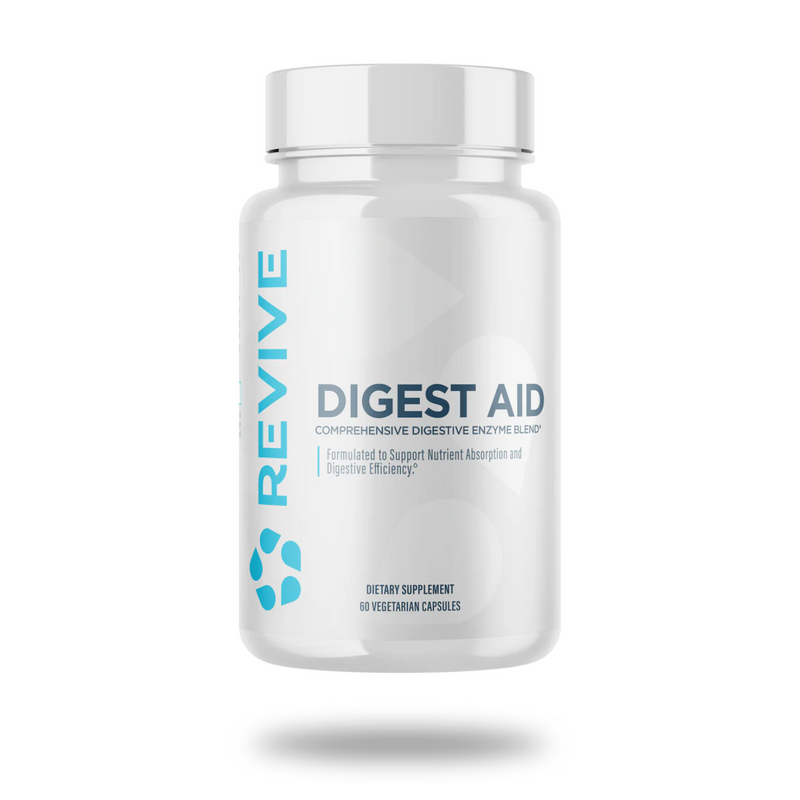
 Revive | Digest Aid | 90 CapsulesRevive
- SuppVault Score
- 77/100
- Per serving
- $0.44
Key actives
Tested
Revive
Broad-spectrum enzymes plus bitters for real mixed-meal digestive support
$39.99 $49.99$0.44/serving SuppVault Summary
Broad-spectrum digestive enzyme formula with artichoke and gentian for real mixed-meal support. Best for protein-heavy, dairy-heavy, or high-fiber meals that leave you bloated, heavy, or gassy.
Revive publishes test results from independent third-party labs. Svpplements links to the manufacturer’s data — we don’t test products ourselves.
Discount applied automatically in cart.

Digest Aid works at the meal level by breaking food down more efficiently, while a probiotic supports the gut ecosystem over time. This is a smart pairing for users who want both immediate digestive comfort and broader microbiome support.
Digest Aid with meals; probiotic daily as directed

Some digestive issues come from poor meal breakdown, while others come from inadequate fiber intake and inconsistent bowel regularity. Pairing this with a quality fiber product covers both digestion and elimination support.
Digest Aid with meals; fiber away from your largest enzyme-supported meal if preferred

Glutamine is often used to support intestinal tissue integrity and recovery during periods of stress, travel, or heavy training. Digest Aid helps with food breakdown, while glutamine can complement the gut lining side of the equation.
Digest Aid with meals; glutamine between meals or post-training

For users with more comprehensive digestive goals, Revive GI can complement Digest Aid by addressing broader GI comfort beyond enzyme support alone. This pairing makes sense when meal digestion is only one part of the problem.
Digest Aid with meals; GI as directed on label
Different tools for different jobs: GI is broader GI support, while Digest Aid is more directly meal-focused.
If your priority is microbiome support over meal-time enzyme action, a probiotic is the better fit.
Revive stands out with artichoke and gentian plus a broad, activity-unit-disclosed enzyme profile.
If irregularity from low fiber is the core issue, Fiber is the more direct solution.
Side-by-side against the closest competitors. Score reflects clinical dosing, transparency, and testing.
Revive | Digest Aid | 90 CapsulesRevive
 Revive | GI+ | 30 ServingsRevive
Different tools for different jobs: GI is broader GI support, while Digest Aid is more directly meal-focused.
Compare side-by-side →If your priority is microbiome support over meal-time enzyme action, a probiotic is the better fit.
Compare side-by-side → Bucked Up | Pre Workout | 120 CapsulesBucked Up
Revive stands out with artichoke and gentian plus a broad, activity-unit-disclosed enzyme profile.
Compare side-by-side →Comparison data combines live storefront pricing with our SuppVault analysis. Competitor scores reflect public-label data; manufacturer-side changes may not be reflected in real time.
Revive Digest Aid is a broad-spectrum digestive support formula designed around one central idea: mixed meals require mixed digestive tools. Instead of leaning on a single enzyme or a generic “digestive blend” marketing angle, this formula combines multiple carbohydrate-, protein-, fat-, dairy-, and fiber-targeting enzymes with artichoke leaf extract and gentian root extract to support the upstream digestive environment. The result is a meal-time formula aimed at reducing that common cascade of heaviness, bloating, gas, and incomplete breakdown that often follows large protein servings, dairy, fibrous vegetables, or higher-fat meals.
The enzyme backbone is the main story here. Amylase at 7,650 DU helps hydrolyze starches and complex carbohydrates into smaller sugars that can be more efficiently absorbed in the small intestine. That matters because undigested carbohydrates are a major trigger for post-meal fermentation and abdominal distention. Protein digestion is covered from multiple angles with Protease 4.5 at 20,400 HUT, Protease 6.0 at 2,550 HUT, Protease 3.0 at 2,550 HUT, Neutral Protease at 3,825 PC, and Peptidase at 2,550 HUT. This multi-protease strategy is smart because different proteases work best across different pH ranges and peptide targets, so the formula is designed to keep protein breakdown moving from the stomach into the small intestine rather than relying on one enzyme in one environment.
Bromelain and papain add another layer of proteolytic support. Bromelain, supplied here at 382,500 FCC PU, is a pineapple-derived proteolytic complex with established use in digestive support, particularly around protein-containing meals. Papain at 357,000 USP units complements that protease coverage by cleaving peptide bonds through a different enzymatic mechanism. Together, these help make dense protein meals and shakes feel lighter and less likely to sit heavily.
For dairy and gas-prone carb foods, Revive included Lactase at 816 ALU and Alpha-galactosidase at 102 GaIU. Here honesty matters: the strongest clinical support in this category belongs to lactase, but typical standalone lactase products are often dosed much higher, commonly in the 3,000-9,000 FCC unit range. This means the lactase dose here is best viewed as supportive inside a broad-spectrum blend rather than a dedicated lactose intolerance solution. The same is true for alpha-galactosidase, where clinical use often centers on higher-potency pre-meal dosing for beans and cruciferous vegetables. Included here, it still adds useful coverage, but this is not a replacement for a fully targeted single-enzyme product if lactose or legume intolerance is your primary issue.
Lipase at 1,070 FIP helps with dietary fat breakdown, while cellulase, xylanase, pectinase, invertase, glucoamylase, acid maltase, and related carbohydrases expand coverage to plant fibers and complex sugars that often drive fullness and fermentation. Artichoke leaf extract standardized to 5% cynarin at 150 mg and gentian root extract 4:1 at 100 mg round the formula out with classic bitter support. Artichoke is associated with bile flow and fat digestion support, while gentian has a long history of use as a digestive bitter to stimulate gastric activity.
The synergy here is practical: enzymes handle substrate breakdown, while the bitters help prepare the digestive environment. The limitation is transparency. Revive does disclose the enzyme activity units, which is exactly how enzymes should be evaluated, but the label is still technically built around a proprietary blend format. That is better than most hidden enzyme blends because you can at least assess activity, yet it is still not full modern transparency by ingredient weight.
What to expect: on day one, the benefit is mostly experiential after meals—less heaviness, less pressure, and better tolerance of larger or more varied meals. Over 2-4 weeks of consistent use with your hardest-to-digest meals, the biggest win is often behavioral: better consistency with food intake, fewer skipped meals due to digestive discomfort, and a more reliable relationship with high-protein eating.
Digestive enzymes are defined by what they do, not just how much they weigh. A small amount of a highly active enzyme can outperform a much larger amount of a weaker raw material, which is why units like HUT, DU, FIP, and ALU are the correct way to evaluate real digestive capacity. In practical terms, activity-unit disclosure gives the buyer a functional view of the formula rather than a decorative one. That is especially important in the digestive category, where milligram-only labels can be highly misleading.
Protein digestion does not happen under one static condition. Gastric and intestinal phases differ in pH and substrate availability, so combining proteases with different functional ranges improves the likelihood that larger dietary proteins will be progressively hydrolyzed into smaller peptides and amino acids. That is why Revive’s inclusion of multiple proteases plus bromelain, papain, and peptidase is more intelligent than a single-enzyme approach. For high-protein eaters, this is one of the most relevant design choices in the formula.
Lactase addresses lactose, the disaccharide in dairy that causes bloating, cramping, and gas when it is not broken down in the small intestine. Alpha-galactosidase addresses raffinose-family oligosaccharides in beans, lentils, and certain vegetables, preventing bacterial fermentation lower in the gut. These are mechanistically distinct problems, which is why both enzymes can coexist in a broad-spectrum digestive formula. The strongest clinical evidence here belongs to lactase, with alpha-galactosidase supported by moderate but practical data.
Artichoke and gentian are not enzymes; they influence digestive readiness. Bitter herbs have long been used to stimulate aspects of gastric and biliary function, which can improve how the body handles richer or more complex meals before breakdown becomes the limiting step. In formulation terms, that makes them complementary to enzymes rather than redundant with them. This is one reason enzyme-plus-bitter formulas often feel more complete than enzyme-only products.
Verified athletes can view NCAA, WADA, and high-school compliance status for this product.
* These statements have not been evaluated by the Food and Drug Administration. This product is not intended to diagnose, treat, cure, or prevent any disease. Consult your physician before use if you have a medical condition or take medications.
Drop your number and our team will instantly text you.
Our team is on it. Check your texts — real advice, real fast.
Brain-curated complementary picks for synergy and full-spectrum coverage.
 70
70

 64
64
 97
97
 69
69
 64
64
 87
87
Secure sign in
Svpplements uses Shopify Customer Accounts for protected login, order history, and account data.

