

This product
 Magnum Nutraceuticals | G-Spring | 48 CapsulesMagnum Nutraceuticals
- SuppVault Score
- 90/100
- Per serving
- $0.96
Key actives
Tested
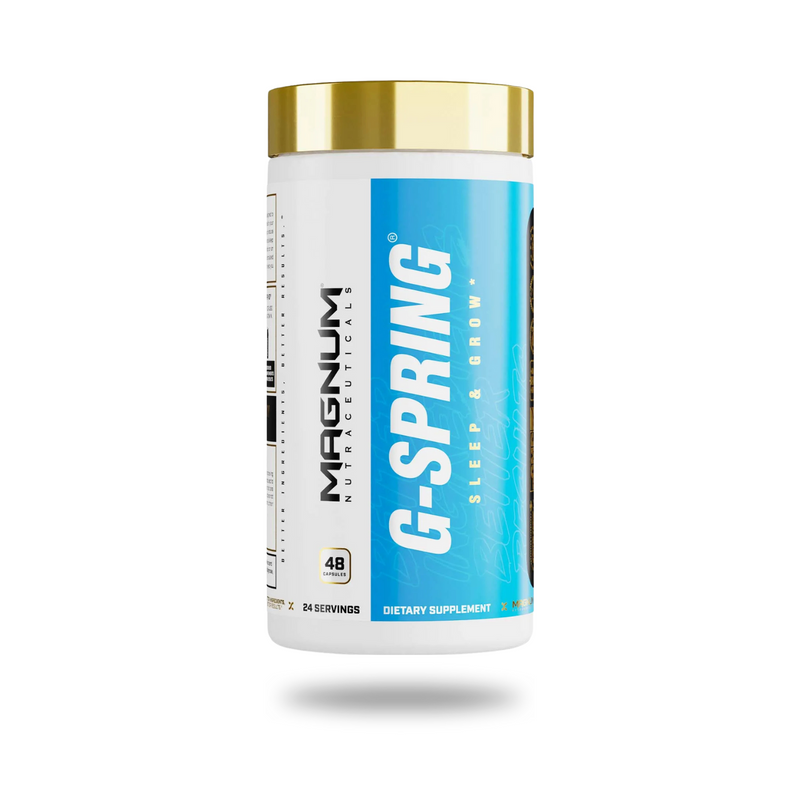
Magnum Nutraceuticals
High-dose melatonin with targeted nighttime recovery support
$22.99 $0.95/serving
Scored on what's in the tub, not the marketing.
The label is the formula. We score it either way.
SuppVault Summary
Magnum G-Spring is a targeted nighttime recovery formula built to help you fall asleep and quiet a wired nervous system. It centers on 10mg melatonin, then layers theanine, bacopa, arginine pyroglutamate, and lysine for a more specialized option than basic melatonin-only products.
| Ingredient | Amount Per Serving | % Daily Value |
|---|---|---|
| Bacopa Monnieri 30:1 Extract (50% Bacosides A&B) | 110mg | † |
| Deanol (from Deanol Bitartrate) | 18.5mg | † |
| L-Arginine Pyroglutamate | 500mg | † |
| L-Lysine | 500mg | † |
| L-Theanine | 50mg | † |
| Melatonin | 10mg | † |
| Mucuna Pruriens Extract | 150mg | † |
| Puerarin (from Kudzu Root) | 50mg | † |
| Vitamin D3 | 12.5mcg | † |
† Daily Value (DV) not established for this ingredient.
Magnum Nutraceuticals publishes test results from independent third-party labs. Svpplements links to the manufacturer’s data — we don’t test products ourselves.
Discount applied automatically in cart.


G-Spring handles the nighttime side of recovery, while creatine supports ATP regeneration, training output, and long-term strength adaptation. The combination makes sense for serious lifters because one supports sleep quality and routine, and the other supports phosphocreatine availability and performance progression.
Take creatine daily any time; take G-Spring 30-60 minutes before bed.
Melatonin is strongest for sleep timing, but magnesium glycinate adds muscular relaxation and nervous system support that many athletes find complements bedtime formulas well. This stack is especially useful for hard-training users dealing with tension, cramps, or difficulty fully winding down.
Take magnesium with dinner or 30-60 minutes before bed alongside G-Spring.
If your goal is total nighttime recovery, pairing a slow-digesting protein with G-Spring gives you both the sleep-support side and a prolonged amino acid supply through the overnight window. That makes particular sense during muscle-building phases or calorie deficits.
Take protein 30-90 minutes before bed; take G-Spring 30-60 minutes before bed.
Many athletes mistake dehydration-related restlessness, cramps, or elevated evening stress for pure insomnia. A hydration product earlier in the evening can support fluid and mineral balance, while G-Spring handles the sleep-onset and calming side.
Use electrolytes earlier in the evening or around training; use G-Spring closer to bedtime.
G-Spring offers a broader nighttime recovery formula than plain melatonin alone.
Revive Sleep is likely more balanced for full-spectrum nightly sleep support and gentler dosing.
Dozer is generally more comprehensive for sleep architecture, while G-Spring is more melatonin-driven.
Both target aggressive nighttime support, but G-Spring stands out for its disclosed amino-based angle.
Side-by-side against the closest competitors. Score reflects clinical dosing, transparency, and testing.
Magnum Nutraceuticals | G-Spring | 48 CapsulesMagnum Nutraceuticals
 HI TECH PHARMACEUTICALS, INC. | Hi-Tech Melatonin | 60 TabletsHI TECH PHARMACEUTICALS, INC.
G-Spring offers a broader nighttime recovery formula than plain melatonin alone.
Compare side-by-side → Revive | Sleep | 30 ServingsRevive
Revive Sleep is likely more balanced for full-spectrum nightly sleep support and gentler dosing.
Compare side-by-side →Dozer is generally more comprehensive for sleep architecture, while G-Spring is more melatonin-driven.
Compare side-by-side →Comparison data combines live storefront pricing with our SuppVault analysis. Competitor scores reflect public-label data; manufacturer-side changes may not be reflected in real time.
Magnum G-Spring is not a generic sleep capsule. It is a targeted nighttime recovery formula built around three connected goals: help you fall asleep, calm the nervous system, and create a sleep window that supports recovery-focused endocrine signaling. The strategy is clear from the label: a strong melatonin dose for sleep initiation, theanine and bacopa for mental quieting, and a classic arginine-plus-lysine backbone with additional support from mucuna and puerarin for a more specialized nighttime formula than category-average melatonin products.
The anchor ingredient is melatonin at 10mg. Mechanistically, melatonin binds MT1 and MT2 receptors in the suprachiasmatic nucleus to reinforce the body’s sleep-wake rhythm and reduce sleep latency. Clinically, melatonin has strong evidence for helping people fall asleep, but most research lands in a much lower range of roughly 300mcg to 5mg. That makes 10mg a high dose by evidence standards. Many users will feel that as a stronger "lights out" effect, but it also means this is not a low-key beginner formula; some people may wake with next-morning grogginess, especially if they do not allow a full night of sleep.
L-theanine is included at 50mg. Theanine works by modulating glutamate signaling and increasing alpha-wave activity while supporting GABA, dopamine, and serotonin tone. The research-backed range is usually 100-400mg, so 50mg sits below the typical standalone clinical range. In this context, it is best viewed as a supporting ingredient rather than the main event, adding smoothness to the melatonin experience rather than driving the formula on its own.
Bacopa monnieri 30:1 extract at 110mg, standardized to 50% bacosides A and B, is a more interesting inclusion. Bacopa is traditionally used for stress resilience, memory, and nervous system support. At this concentration, the formula provides a meaningful amount of bacosides despite the modest capsule weight, which may help take the edge off a racing mind over time. This is less about a dramatic acute sedative effect and more about smoothing mental overactivity with consistent use.
L-arginine pyroglutamate at 500mg plus L-lysine at 500mg reflects a classic pairing historically discussed in growth hormone support formulas. Lysine also has data for anxiolytic effects and interacts with serotonergic signaling, while arginine is tied to nitric oxide biology and has long been used in amino-based endocrine support concepts. Relative to modern standalone lysine research, 500mg is below the common 1-3g range. So this pairing is directionally aligned with the formula’s nighttime recovery theme, but not aggressively dosed as a high-amino product.
Mucuna pruriens extract at 150mg adds another distinctive layer. Mucuna naturally provides L-DOPA precursors that interact with dopaminergic pathways. In nighttime recovery formulas, that can be used to support mood, motivation tone, and the broader neuroendocrine profile. Exact impact depends heavily on extract potency, and this label does not specify standardization to L-DOPA, so it should be viewed as potentially useful but not fully assessable with the same precision as a standardized raw.
Puerarin at 50mg is a niche addition from kudzu root. It has limited but interesting evidence in estrogen-receptor signaling, reward pathways, and broader metabolic modulation. At 50mg, it is not a headline clinical dose by modern extract standards, but it reinforces the formula’s specialized hormone-support positioning. Deanol at 18.5mg is also present, though this is well below the 300-600mg range typically discussed for oral DMAE, making it a minor supporting inclusion at best. Vitamin D3 at 12.5mcg rounds out the formula with basic endocrine and general wellness support.
The synergy here matters more than any single non-melatonin ingredient. Melatonin initiates sleep. Theanine and bacopa help quiet the brain. Arginine pyroglutamate, lysine, mucuna, and puerarin give the formula its distinct nighttime recovery identity rather than making it just another sedative capsule. Just as important, Magnum uses a fully disclosed label with no proprietary blend, which is a major trust advantage in a category full of vague "GH support" formulas. Day 1, expect stronger sleep onset and a calmer transition to bed. Over 2-4 weeks, the formula is better judged by how consistently you fall asleep, how restored you feel on waking, and how well your nighttime routine holds up through hard training blocks.
Melatonin primarily acts through MT1 and MT2 receptors within the suprachiasmatic nucleus, the brain's central circadian pacemaker. Activation of these receptors shifts the neurobiological state toward sleep readiness by lowering wake-promoting signaling and reinforcing circadian timing cues. The largest acute effect is usually on sleep latency rather than deep-sleep enhancement per se. At higher doses, receptor saturation may occur, which can improve sleep onset for some users but also raise the chance of residual morning heaviness.
L-theanine is thought to promote a calmer neurocognitive state by modulating glutamatergic signaling and increasing alpha-wave activity associated with relaxed wakefulness. Bacopa monnieri has a different profile, with longer-horizon effects linked to cholinergic modulation, antioxidant activity, and adaptation to stress signaling rather than heavy acute sedation. Together, they support the subjective feeling of reduced mental noise before bed. In this formula, their role is complementary to melatonin rather than substitutive.
Arginine and lysine have historically been paired in nighttime products because both amino acids participate in broader metabolic and endocrine physiology relevant to recovery. Arginine contributes to nitric oxide biology and vascular regulation, while lysine is involved in protein metabolism and has limited evidence in stress-response contexts. Their inclusion does not guarantee a direct anabolic effect during sleep, but it does create a more recovery-oriented profile than a simple single-ingredient sleep aid. This pairing is best understood as supportive infrastructure rather than the main sleep driver.
Mucuna pruriens naturally contains L-DOPA precursors that can influence dopaminergic tone after conversion within the body. Dopamine has complex relationships with mood, motivation, endocrine signaling, and sleep-wake regulation, so the context and dose matter substantially. In nighttime formulas, mucuna is usually positioned less as a sedative and more as part of a specialized recovery-hormonal strategy. That also means it deserves extra caution in users taking medications that affect dopamine pathways.
G-Spring is a nighttime recovery formula designed to help you fall asleep more easily and support a calmer pre-bed transition. The formula is centered on 10mg melatonin, with additional support from L-theanine, bacopa monnieri, arginine pyroglutamate, lysine, mucuna pruriens, puerarin, deanol, and vitamin D3.
Each 2-capsule serving provides 10mg melatonin. That is a high dose relative to the common research range of roughly 300mcg to 5mg, so users who are sensitive to melatonin should consider starting with 1 capsule to assess tolerance.
Take it 30-60 minutes before your intended bedtime with water. That window gives melatonin time to begin shifting you toward sleep as you dim lights, put screens away, and get into your bedtime routine.
It can be used nightly when sleep support is needed, especially during stressful training blocks, travel, or disrupted schedules. Because the melatonin dose is strong, some users prefer to use it strategically rather than automatically every night.
It can, especially if you are sensitive to melatonin, take it too late, or do not allow enough time for a full night of sleep. The 10mg melatonin dose is above the typical studied range, which is part of why many users find it strong.
This pairing has a long history in nighttime and recovery-oriented formulas aimed at supporting the body’s overnight recovery environment. Lysine also has its own relevance to stress modulation, while arginine contributes to nitric oxide and broader amino-based recovery support.
G-Spring provides 50mg L-theanine, which is below the common standalone research range of 100-400mg. In this formula, theanine is better viewed as a supporting ingredient that helps smooth the overall experience rather than acting as the primary driver.
Plain melatonin products focus almost entirely on sleep onset. G-Spring adds bacopa, arginine pyroglutamate, lysine, mucuna pruriens, puerarin, deanol, and vitamin D3, creating a more specialized nighttime recovery profile aimed at athletes and performance-minded users.
Yes, many users pair it with magnesium glycinate or another non-melatonin relaxation product for broader bedtime support. Just avoid doubling up on additional melatonin until you know exactly how the 10mg serving affects you.
No caffeine is listed, and the formula is functionally stim-free. It is designed for nighttime use, so its purpose is the opposite of a pre-workout: to help you wind down and protect recovery.
Verified athletes can view NCAA, WADA, and high-school compliance status for this product.
* These statements have not been evaluated by the Food and Drug Administration. This product is not intended to diagnose, treat, cure, or prevent any disease. Consult your physician before use if you have a medical condition or take medications.
Drop your number and our team will instantly text you.
Our team is on it. Check your texts — real advice, real fast.


Secure sign in
Svpplements uses Shopify Customer Accounts for protected login, order history, and account data.