This product
 Core Nutritionals | Glutamine | 60 ServingsCore Nutritionals
- SuppVault Score
- 78/100
- Per serving
- $0.33
Key actives
Tested
Core Nutritionals
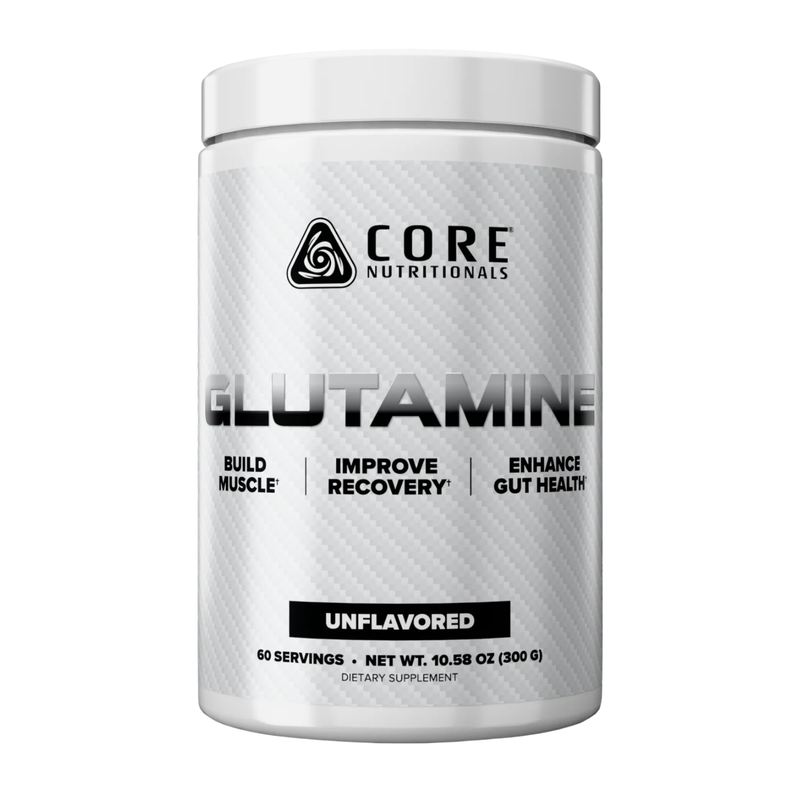
5g pure L-Glutamine. Fully transparent. Recovery without the hype.
$19.99 $0.33/serving
Scored on what's in the tub, not the marketing.
The label is the formula. We score it either way.
SuppVault Summary
Core Nutritionals Glutamine is a transparent single-ingredient recovery formula delivering 5,000mg of L-Glutamine per serving. It’s best suited for recovery, gut support, and resilience during hard training phases. No proprietary blend, no filler, just a research-relevant 5g dose.
| Ingredient | Amount Per Serving | % Daily Value |
|---|---|---|
| L-Glutamine | 5000mg | † |
† Daily Value (DV) not established for this ingredient.
Core Nutritionals publishes test results from independent third-party labs. Svpplements links to the manufacturer’s data — we don’t test products ourselves.
Discount applied automatically in cart.


Creatine and glutamine solve different problems, which is exactly why they stack well. Creatine supports phosphocreatine replenishment and high-intensity performance, while glutamine is more relevant for recovery stress, gut support, and overall resilience during demanding training blocks.
Take creatine daily at any convenient time; take glutamine post-workout or at another consistent daily time.
Protein supplies the essential amino acids needed for muscle protein synthesis, while glutamine adds targeted support for recovery-related systems not fully covered by protein alone. This is a practical pairing for athletes who want post-workout muscle repair plus broader recovery support.
Mix glutamine into your post-workout protein shake or take both immediately after training.
The ingredient knowledge base specifically notes synergy between glutamine and branched-chain amino acids. BCAAs or EAAs support training-day amino availability, while glutamine complements that with support for gut and immune-demanding recovery processes.
Use EAAs or BCAAs during or around training; use glutamine post-workout or separately later in the day.
Glutamine has known synergy with electrolytes such as sodium and potassium, especially for athletes performing long sessions or sweating heavily. This pairing makes sense when endurance load, heat, or high training frequency is stressing both hydration status and broader recovery systems.
Use electrolytes during training or throughout the day; take glutamine post-workout or with a recovery meal.
For direct strength and performance output, creatine has stronger evidence and broader athletic utility.
Both are straightforward standalone glutamine products, so the main differences are brand preference and value.
This is another transparent single-ingredient glutamine option with a very similar use case.
If you only want pure glutamine dosing without extra digestive ingredients, this is the simpler tool.
Side-by-side against the closest competitors. Score reflects clinical dosing, transparency, and testing.
Core Nutritionals | Glutamine | 60 ServingsCore Nutritionals
 Core Nutritionals | Creatine MonohydrateCore Nutritionals
For direct strength and performance output, creatine has stronger evidence and broader athletic utility.
Compare side-by-side → APS Nutrition | L-Glutamine | 100 ServingsAPS Nutrition
Both are straightforward standalone glutamine products, so the main differences are brand preference and value.
Compare side-by-side → RYSE | L-Glutamine | 60 ServingsRYSE
This is another transparent single-ingredient glutamine option with a very similar use case.
Compare side-by-side →Comparison data combines live storefront pricing with our SuppVault analysis. Competitor scores reflect public-label data; manufacturer-side changes may not be reflected in real time.
Core Nutritionals Glutamine is a straightforward single-ingredient amino formula built around one job: delivering a full 5,000mg serving of L-Glutamine with no proprietary blend and no distraction from what the product actually is. That formulation philosophy matters. In a category where glutamine is often buried inside recovery blends or sold with exaggerated promises about muscle growth, Core takes the cleaner and more credible route: one ingredient, one research-relevant dose, full transparency.
L-Glutamine is the most abundant conditionally essential amino acid in the body. Under normal circumstances, your body synthesizes substantial amounts on its own, but heavy training, prolonged exhaustive exercise, caloric restriction, illness, gut stress, or other forms of physical strain can increase demand. Mechanistically, glutamine functions as a major nitrogen carrier and a key metabolic fuel for rapidly dividing cells, especially enterocytes in the gut lining and lymphocytes in the immune system. That is the real reason glutamine remains relevant in sports nutrition. It is not because it directly builds more muscle in healthy, well-fed athletes. In fact, the evidence is strong that glutamine is not an effective standalone driver of muscle gain, fat loss, or body recomposition in that population. Where it does make practical sense is recovery support during periods of elevated stress, support for intestinal barrier integrity, and support for immune function when training load is high.
The 5,000mg dose here is important because it lands directly at the bottom of the clinically used range of 5g to 15g. That means this is not a token sprinkle. It is a legitimate daily serving consistent with the literature for gut and recovery-oriented use. At this amount, most users will not “feel” a dramatic acute effect the way they would with caffeine or nitric oxide boosters. Glutamine is subtler than that. What you are more likely to notice is that it fits into a recovery plan cleanly: easier compliance, better support when training volume climbs, and a useful tool for athletes whose digestion or overall resilience tends to get worse during harder phases.
Synergy-wise, glutamine works best as part of a broader recovery stack. It pairs naturally with BCAAs or essential amino acids in intra- or post-workout settings, and it also makes sense alongside electrolyte formulas for athletes doing long sessions or sweating heavily. That synergy reflects glutamine’s role in systemic recovery rather than acute performance enhancement.
From a transparency standpoint, this is exactly what serious buyers should want from a single-ingredient powder. No blend, no hidden doses, no inflated claim architecture. Just 5 grams of L-Glutamine per scoop across 60 servings. Compared with category norms, that level of label clarity is a strength.
What should you expect? On day one, mostly nothing dramatic—and that honesty matters. This is not a stimulant and not a pump product. Over 2 to 4 weeks of consistent use, especially during hard training, dieting, endurance work, or GI stress, this formula is designed to support the systems glutamine actually influences most: gut lining integrity, immune demand, and recovery capacity under strain.
Glutamine is the most abundant free amino acid in plasma and skeletal muscle, but demand can rise sharply during physiological stress. In those settings, endogenous synthesis may become insufficient relative to tissue requirements, which is why glutamine is often called conditionally essential. Exercise, caloric restriction, illness, and high training volume can all increase turnover. Supplemental intake helps maintain circulating availability when recovery demands are elevated.
Enterocytes use glutamine as a major oxidative fuel, making it relevant to intestinal barrier maintenance under stress. Adequate glutamine availability supports mucosal integrity, cellular turnover, and the energy needs of rapidly dividing gut tissue. This is one reason glutamine is more consistently supported for gut-related applications than for direct hypertrophy outcomes. Athletes under heavy endurance or dieting stress may value this role most.
Lymphocytes and other immune cells rely on glutamine as a meaningful substrate for proliferation and metabolic activity. Periods of repeated high training stress may lower circulating glutamine availability, which has led to interest in supplemental support for overall resilience. The mechanism is biologically plausible because immune cells use glutamine not only for energy, but also for nitrogen transfer and biosynthetic processes. That said, outcome data in healthy athletes remain more mixed than mechanistic data alone.
Although glutamine is abundant in muscle tissue, supplementation has not consistently translated into greater muscle mass or strength gains in healthy resistance-trained populations. Mechanistically, it does not provide the same anabolic signaling profile as leucine-rich essential amino acid feeding. Its value is better framed as recovery context support rather than a primary hypertrophy driver. That distinction helps align expectations with the evidence base.
Each scoop provides 5,000mg of L-Glutamine. That matches the low end of the clinically used 5g to 15g range, making it a legitimate standalone dose rather than a token amount hidden inside a blend.
Yes. Five grams is a research-relevant serving and a common starting point for athletes using glutamine for gut support, recovery support, and resilience during physically stressful training phases.
Not directly in the way creatine or adequate total protein intake do. The evidence does not support glutamine as a strong standalone muscle-building ingredient in healthy athletes, but it can still be useful for recovery support, gut lining support, and immune-demanding training periods.
L-Glutamine is the most abundant conditionally essential amino acid in the body and is used heavily by gut lining cells and immune cells. It also plays a role in nitrogen transport and whole-body amino acid metabolism, especially when physical stress is high.
Post-workout is a common and practical option, but the most important factor is daily consistency rather than exact timing. It can also be taken between meals, with a protein shake, or at another convenient time in your routine.
Yes. Core Nutritionals Glutamine stacks very well with creatine monohydrate, whey or isolate protein, EAAs, BCAAs, and hydration formulas because it serves a different role and does not duplicate their primary mechanisms.
Probably not, and that is normal. Glutamine is not a stimulant, nootropic, or pump ingredient, so its value is in consistent recovery-oriented support rather than an immediate buzz or performance sensation.
No. This is a fully transparent single-ingredient formula with 5,000mg of L-Glutamine per serving and no proprietary blend hiding the dose.
Yes, that is one of the more sensible use cases. During calorie restriction and hard training, recovery stress and digestive fragility often increase, and glutamine is often used to support those systems.
No standard cycling protocol is required. Since glutamine is an amino acid used for recovery support rather than a stimulant or hormone-active ingredient, it is generally used continuously during demanding training blocks.
Verified athletes can view NCAA, WADA, and high-school compliance status for this product.
* These statements have not been evaluated by the Food and Drug Administration. This product is not intended to diagnose, treat, cure, or prevent any disease. Consult your physician before use if you have a medical condition or take medications.
Drop your number and our team will instantly text you.
Our team is on it. Check your texts — real advice, real fast.


Higher-scoring formulas SuppVault ranks above this product.


Secure sign in
Svpplements uses Shopify Customer Accounts for protected login, order history, and account data.